Cannes Lions International Festival of Creativity
Health & Wellness - Creative Data - Gold
Health & Wellness - Integrated - Silver
Design - Design-Driven Effectiveness - Silver
PR - Research, Data & Analytics - Bronze
Creative Strategy - Data & Analytics - Bronze
Direct - Not-for-Profit / Charity / Government - Shortlist
Direct - Use of Print/Outdoor - Shortlist
Health & Wellness - Direct - Shortlist
Creative Data Collection & Research - Shortlist
Creative Data - Single-Market Campaign - Shortlist
Creative Data - Data-Driven Targeting - Shortlist
Design - Digital Design - Shortlist
Creative Strategy - Not-for-profiit/charity/governments - Shortlist
One Show
Creative Use of Data - Gold
Craft / Data-Driven Personalization - Silver
Innovation / Execution in Health & Wellness - Bronze
Data-Driven Personalization - Merit
Public Relations - Merit
D&AD
Digital Experience Design / Use of Data - Graphite Pencil
Health & Wellbeing / Integrated - Wood Pencil
Digital Marketing / Use of Data - Shortlist
Digital Experience Design / Data Visualisation & Storytelling - Shortlist
ADC
Design for Good / Health / Wellness - Gold
Advertising / Out of Home - Gold
Experiential Design / Digital Experiences - Gold
Interactive / Data Visualization - Gold
Data Visualization - Merit
CLIO
Digital / Mobile & Social Media Craft - User Experience (UX) - Gold
Digital / Mobile & Social Media Craft - User Interface (UI) - Gold
Design - Digital/Mobile - Silver
Digital / Mobile - Website - Silver
Experience / Activation - Digital / Mobile & Social Media - Silver
Health Equity - Health Equity - Bronze
Creative Effectiveness - Local / Regional - Bronze
Direct -Out of Home - Bronze
Out of Home - Mixed Campaign - Bronze
Creative Use of Data - Targeting / Personalization - Shortlist
LIA
Health & Wellness - Craft - UI - User Interface & Navigation - Gold
Creativity in Media - Use of Outdoor - Silver
Design - Creative Use of Data - Silver
Design - Data Visualization - Silver
Health & Wellness - Creative Use of Data - Silver
Health & Wellness - Public Service/Charity/NGO - Silver
Creative Use of Data Campaign - Billboard - Bronze
Creative Use of Data - Data Visualization - Bronze
Creativity In PR - Public and Political Affairs - Bronze
Creativity In PR - Public Service/Charity/NGO - Shortlist
Creative Use of Data - Data Collection and Research - Shortlist
Creativity in Media - Non-profit - Shortlist
Ad Age Marketing Impact Awards
Integrated Campaign of the Year - Gold
Advocacy - Bronze
Best in Show
The Drum Awards
Design use of data & insight - Gold
Charity or Not-for-Profit & Government or Public Sector - Silver
Best website experience - Silver
Social Purpose: Use of Data & Insights - Silver
Media OOH - Silver
Digital for Good - Silver
Social Purpose: Integrated Campaign - Not For Profit - Bronze
Use of Data & Insights - Bronze
Social Purposes - BIG Thinking - Bronze
Social Purpose: Charity or Not for Profit - Shortlist
Use of location - Shortlist
Context
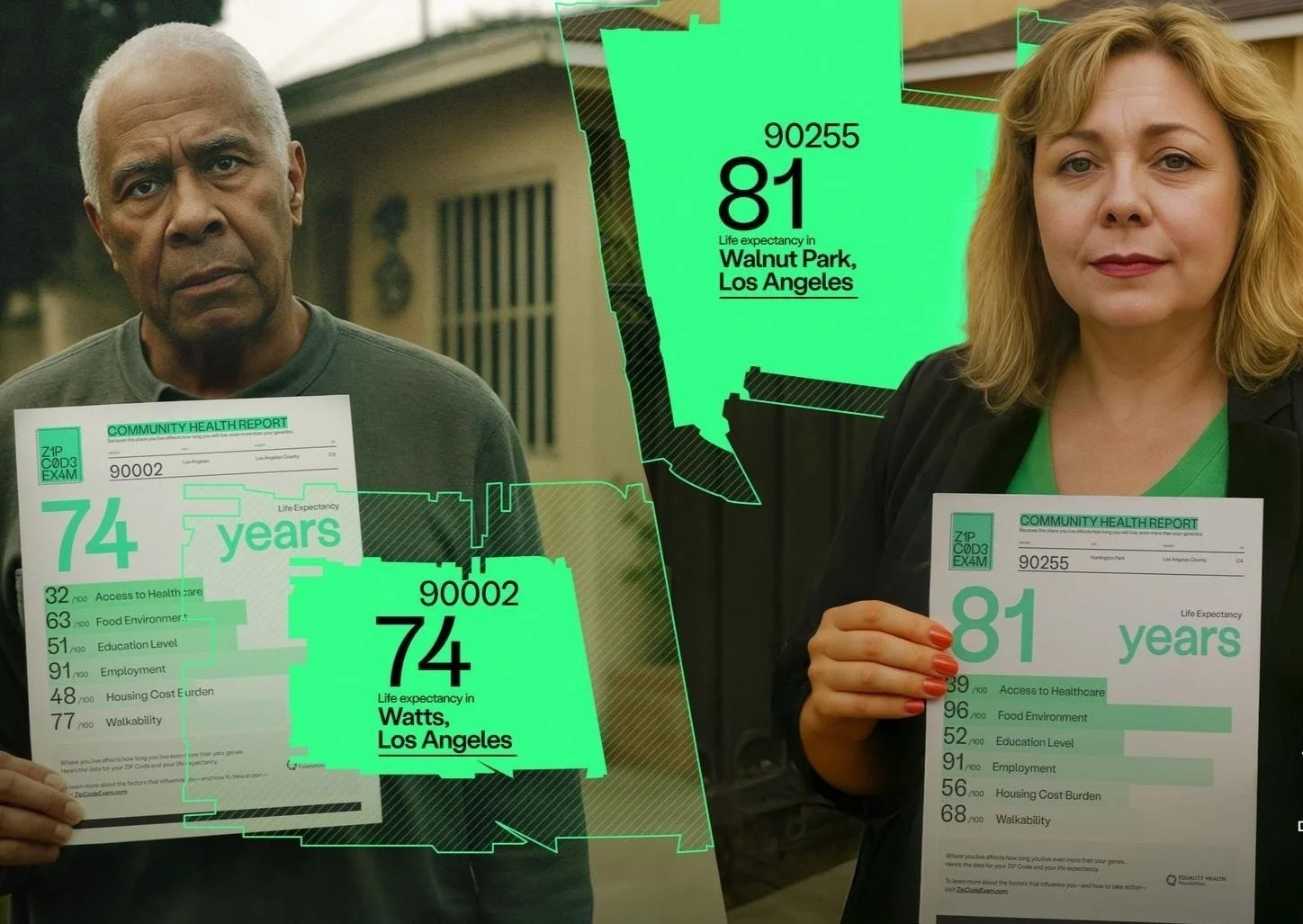
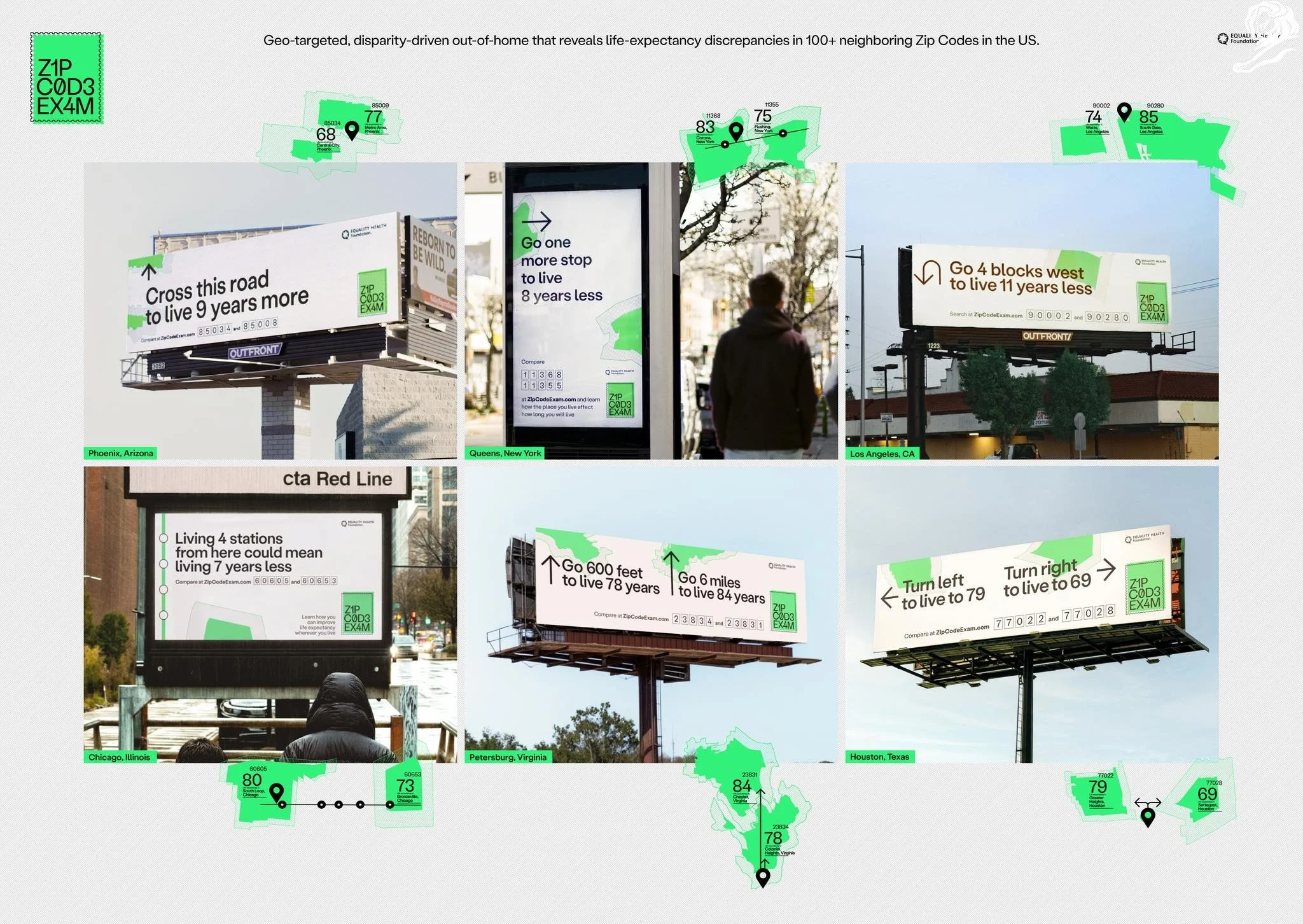
In the U.S., where you live can shape how long you live. Across major cities, neighboring zip codes can show life expectancy gaps of more than a decade—not because of genetics or personal choices, but because of systemic conditions like access to healthcare, housing, food, transportation, and economic opportunity.
Yet health is still widely framed as an individual responsibility, leaving these structural drivers largely invisible. Equality Health Foundation has long worked within underserved communities to address these gaps, but with trust eroding and safety nets weakening, the challenge became clear: make health inequity visible, undeniable, and actionable.
Idea & Execution
The Zip Code Exam reframed the health assessment by shifting focus from the individual to the environment.
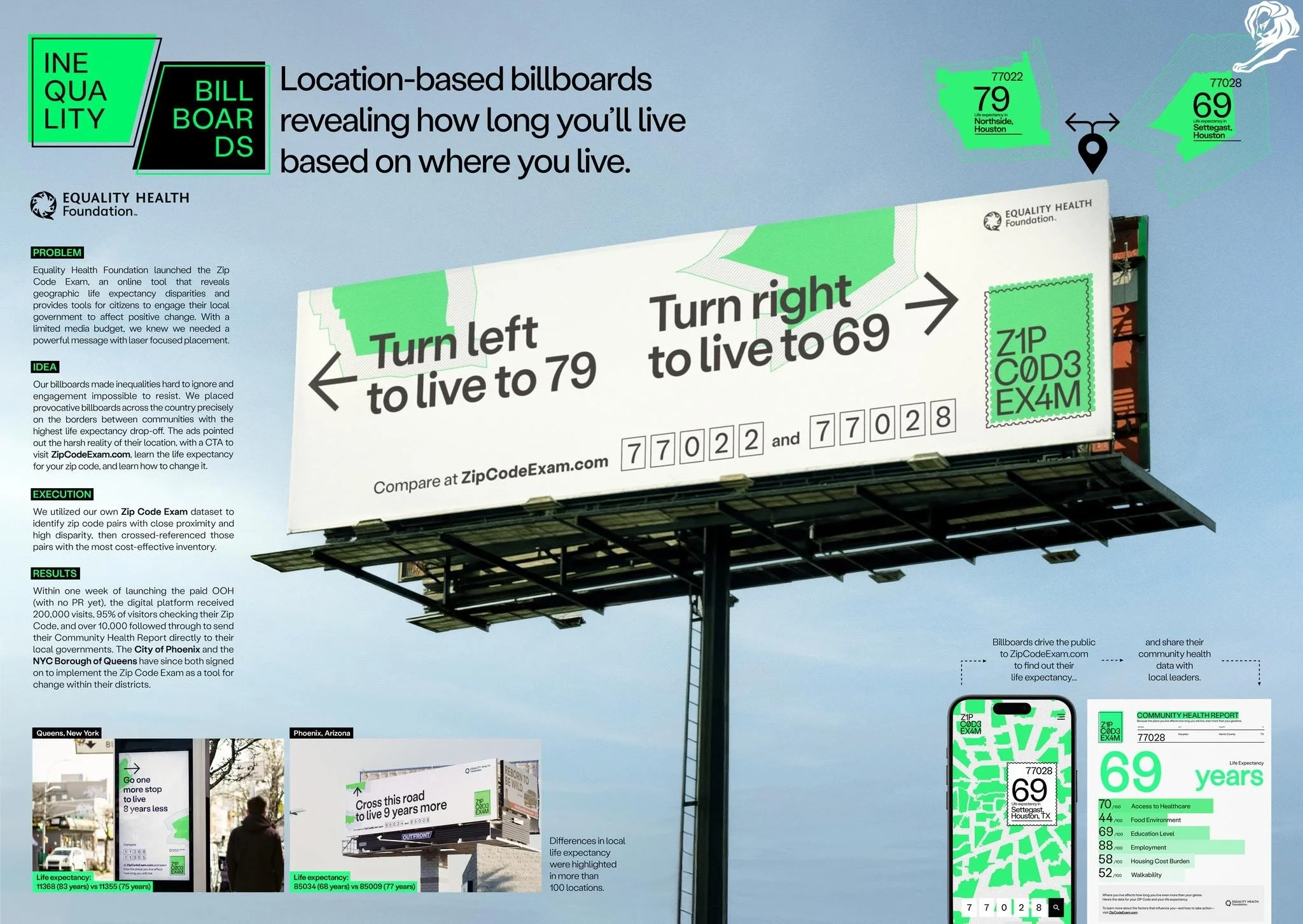
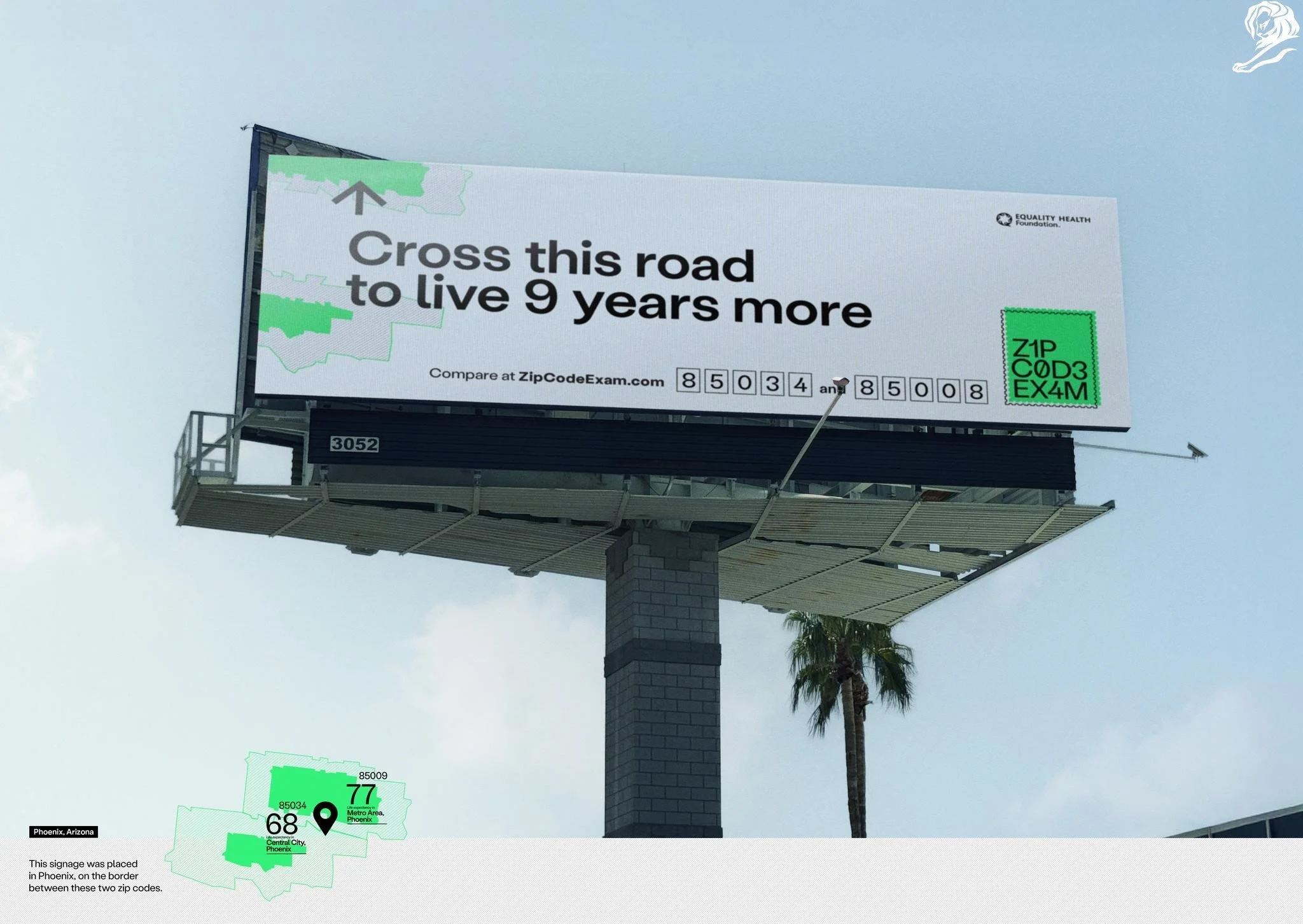
Using over 900,000 public data points across 30,000 U.S. zip codes, we mapped life expectancy against key Social Determinants of Health. That data was activated through a hyperlocal out-of-home campaign placed at the physical borders where disparities begin, and a digital platform—zipcodeexam.com—where users could enter their zip code and receive a Community Health Report.
The platform enables side-by-side comparisons, breaks down the factors shaping local health outcomes, and allows users to share reports directly with local leaders—turning abstract data into personal insight and civic action.
Outcome
Launched in April 2025 across six U.S. cities, the Zip Code Exam drove immediate engagement and real-world impact. Within one week, the site received over 200,000 visits, with more than 10,000 Community Health Reports sent to elected officials.
Most notably, the City of Phoenix and the Borough of Queens in New York City committed to using the Zip Code Exam as part of their annual budgeting process—helping shift the public health conversation from individual behavior to systemic responsibility.